Saturday, January 19, 2013

Project Management


What is a project ?

According to Old Dominion University College of Science (2012), a sequence of tasks planned from beginning to an end bounded by time, resources and required results is a project, in depth it contains a defined outcome and deliverable, deadline and a budget.


Source: CPM Scheduling (2012)

What is project management ? 


Application of knowledge, skills and techniques in order to achieve a particular task efficiently and effectively, thus it ensures that company's bond their project outcomes with their business goals (PMI, 2013). 

APM (2013) mentions that project management is controlling the tools which are used for change, therefore it involves the following factors;
  • Understanding the needs of stakeholders.
  • Planning what needs to be done, when, by whom, and to what standards.
  • Building and motivating the team.
  • Coordinating the work of different people 
Segmentation of project management ? 

As shown by PMI (2013) it is divided into 5 main segments, they are:
  • Initiating
  • Planning
  • Executing
  • Monitoring and Controlling
  • Closing
Virginia Tech Information Technology (2013) has done further explanation of the segments;

Initiating: This is the starting point of any project, hence at this point all the key factors which is associated with achieving a successful project is taken into consideration, thus it is called the pre-sale, it means the service provider shows the capability and the confidence of completing the project as required by the client efficiently and effectively.

Planning: This is one of the key components of the segments, at this point if the team takes a wrong step a domino effect will be created, where all the other steps will be failed. Therefore the team is required to look into this matter detailed, this details includes the scope, budget and timelines. After the finalization of the above requirements the project scheduling is done, for this purpose gantt chart is used in general. 

Executing: After all the paper work is done, comes to the execution phase, where each team member is responsible for carrying out each task efficiently sticking to the timeline, the progress of the team members are monitored using the project detail schedule, most importantly the senior managers of the team requires daily reports of the process and the client may also keep track of the progress.

Monitoring and controlling: This stage is known as the testing stage or it can used as the troubleshooting stage, where the monitoring and controlling is done adhering to the initial protocols made, hence these protocols can be project plan, quality assurance test plan and the communication  plan.

Closing: This step can the conclusion or the closing out of a project, which is the final step of a project before handing it over to the client fruitfully. If all the project matches to the client requirements it is handed over to the client, or else an evaluation is done again to check any mistakes and errors adhering to the protocol. After this stage errors of the project will be a responsibility of the operation team. 


Source: SPM (2012)

Skills associated during project management

Marando (2012) shows that effectively and efficiently management of projects and programs are one of the important skills, however most of the project managers were not able to successfully achieve desired objectives and goals due to the lack of above skill. 
Therefore soft and hard skills are one of the fundamental skills associated with project management, thus balancing it is one of the great challenges faced by many project managers Marando (2012). 

Soft skills: According to Marando (2012) it an interpersonal skill which enables problems solving, influencing, leadership, communication, negotiation, expectation management and decision making also soft skills are vastly intangible.

Hard skills: The exact contrast of the soft skills, this involves the technical aspect of a project manger, generally used during producing tangible deliverables such as work breakdown structure, budget, project schedule, critical path diagram, earned value reports, dashboards etc.  Marando (2012). 

What is a triple constrain ?

Penn State University (2012) shows that each and every project carried out in world progresses adhering to the triple constrain, it includes time, money and scope, therefore it is very important that a project manger identify the constrains clearly as it is very important to stakeholder or the sponsor of the project. 

Source: UOU Higher Education Academy (2012)

Cost- Involves the budget and all the monetary issues related to the project
Time- Involves the schedule and the time constrains related to the project 
Scope- Involves the goals of the project
  Penn State University (2012)


Author understands project management is the key learning outcome of the Business and Information Technology degree, thus it is essential to master the subject in order to achieve a better position in the industry. First and fore most understanding of the skills involved in project management is vital, as 90% of the world's projects are failed due to lack skills in management. As mentioned in the skills area having a balance in the soft and hard skills is needed in order to proceed as a successful project manger. Finally author would like to state that none of the stakeholder or sponsors of projects are not willing to spend a single cent extra apart from their budget as the current world is running to an economic downturn in the long run, thus they expect more for what they pay.

References 

APM, 2013. APM. [Online]
Available at: http://www.apm.org.uk/WhatIsPM
[Accessed 17 01 2013].
CPM Scheduling, 2012. CPM Scheduling. [Online]
Available at: http://www.cpmscheduling.com/index.php/project-management/what-is-a-project
[Accessed 18 01 2013].
Marando, A., 2012. Brandies University. [Online]
Available at: http://projectmgmt.brandeis.edu/downloads/BRU_MSMPP_WP_Feb2012_Balancing_Project_Management.pdf
[Accessed 17 01 2013].
Old Dominion University College of Science , 2012. Old Dominion University College of Science. [Online]
Available at: http://www.cs.odu.edu/~cs410/whatisaproject.htm
[Accessed 18 01 2013].
Penn State University , 2012. Penn State University. [Online]
Available at: http://www.personal.psu.edu/glh10/ist110/topic/topic81/topic81_02.html
[Accessed 18 01 2013].
PMI, 2013. PMI. [Online]
Available at: http://www.pmi.org/About-Us/About-Us-What-is-Project-Management.aspx
[Accessed 17 01 2013].
SPM, 2012. SPM. [Online]
Available at: http://www.s-p-e.com/companyinfo/projectmanagement.htm
[Accessed 17 01 2013].
UOU Higher Education Academy, 2012. Zdnet. [Online]
Available at: http://www.ics.heacademy.ac.uk/Events/HEAYork2005/presentations/Tuesday/Kevin%20and%20Ken/project_mgmt/intro/intro_pm.htm
[Accessed 17 01 2013].
Virginia Tech Information Technology, 2013. Virginia Tech Information Technology. [Online]
Available at: http://www.itplanning.org.vt.edu/pm/processtable.html
[Accessed 17 01 2013].


Thursday, January 17, 2013

Development Methodologies

What is a method ?

It is an established, habitual, logical or prescribed practice or systemic process used in achieving certain tasks with accuracy and efficiently (Business Dictionary , 2012). 


Source: Programme (2012) 
What is a methodology ? 

A system of broad principles or rules from which specific methods derived to interpret or solve different problems within a scope of a particular discipline (Business Dictionary, 2012). 
According to International Research Network  (2012) methodology is a series of choices made, they are;
  • Choices about what information and data to gather 
  • Choices about how to analyze the information and data that you gather 
  • Other methodological choices  
Models and Life cycles 

  1. Spiral model
  2. Waterfall model
  3. V life cycle
  4. Incremental/iterative development
  5. Reusable software model
  6. Automated software synthesis 
  7. Throwaway prototyping model
  8. Evolutionary prototyping mode
Waterfall Project Life Cycle


Source: Holon Institute of Technology (2012)

Sequential development model with clearly defined  deliverables for each phase (ExecutiveBrief, 2012). According to the above life cycle returning back to the previous activity once it is completed is impossible. 

Evolutionary Project Plan

Gilb (1999) mentions that evolutionary project plan is an innovative way to get control over project results, thus it follows the principle "PLAN DO STUDY ACT". 

Spiral Life Cycle 

According to Sikder (2012) spiral model is similar to the incremental model, but concentrates more on the risk analysis factor. 
Spiral model has four phases, they are;
  • Planning
  • Risk analysis
  • Engineering 
  • Evolution  
    (Sikder, 2012)

    Source: Virginia Tech  (2012)


As mentioned by Virginia Tech (2012) in 1998 Barry Boehm proposed a more comprehensive model which is spiral model in order to overcome the inadequacies of the waterfall method.   

Author understand that spiral model is one of the best models that can used during project planining, as spiral model creates a risk driven approach to the software process while waterfall method is primarily document driven or code driven process.

References


Business Dictionary.com, 2012. Business Dictionary.com. [Online]
Available at: http://www.businessdictionary.com/definition/method.html
[Accessed 17 01 2013].
ExecutiveBrief, 2012. Project Smart. [Online]
Available at: http://www.projectsmart.co.uk/which-life-cycle-is-best-for-your-project.html
[Accessed 17 01 2013].
Gilb, T., 1999. SPI Partners. [Online]
Available at: http://www.spipartners.nl/data/Evo99.PDF
[Accessed 17 01 2013].
Holon Institute of Technology, 2012. Holon Institute of Technology. [Online]
Available at: http://www.hit.ac.il/staff/leonidm/information-systems/ch01.html
[Accessed 17 01 2013].
International Research Network , 2012. International Research Network. [Online]
Available at: http://irn.uit.tufts.edu/research_planner/documents/6/methodology_tips.pdf
[Accessed 17 01 2013].
Programme, 2012. Programme. [Online]
Available at: http://programmedevelopment.com/what-is-ability-/ability-and-methods
[Accessed 17 01 2013].
Sikder, F., 2012. Worldpress.com. [Online]
Available at: http://faisalsikder.wordpress.com/2009/12/18/software-development-life-cyclesdlc-spiral-model/
[Accessed 17 01 2013].
Virginia Tech , 2012. Virgina Tech. [Online]
Available at: http://courses.cs.vt.edu/csonline/SE/Lessons/Spiral/index.html
[Accessed 17 01 2013].


Personal Branding

What is a personal brand ?

Your personal brand is the power, clear, positive idea that comes into a people's mind when they think about you. It is what you stand for , the values and abilities that are embedded in you in order to stand out from others. It's a professional alter ego designed for the purpose of influencing how others perceive you.
This can be done by telling your audience the following;

  • Who you are
  • What you do
  • What makes you different
(Marketing Library.net, 2012)
Source: Quick Sprout (2012)


According to Marketing Library.net (2012) in order to maintain perfect personal brand, you must evoke following 3 main perceptions;
  • You are different: ability to see as an original or a unique person, which is one of the most important factors of personal branding that should be followed.
  • Your are superior: You should have the belief that, you are the best among all others and that you provide higher and better high technology service.
  • You are authentic: You brand must be built on the truth of who you are, what your strengths are, what your capabilities are and the love towards the particular work, if one fakes it's personal brand the person will end up loosing their image.   
Practical example; In Sri Lanka the graduates per year is 3750+ but on 7/8 companies hire them from universities, thus they should have a proper personal brand and should be expertise in the particular area. It can be understood that companies not only search for academically qualified graduates, most of them seek for people who has excel in both academic and extra curricular activities. 

There are companies which have built their personal brand successfully, when talking about companies like Coca Cola, Nike, Mc Donals, Google, Pizza Hut, Pepsi, Amazon, Mercedes Benz etc. they have managed to excel in the field of personal branding, basically if a person sees a logo, the brand is identified clearly. 


 Source: Start Up Sources.biz (2012)


Source: Lip Glossiping (2012)


Author understands that maintaining a proper personal brand is essential in the long run. Especially when you enter the industry, when seeking for a job survival of the fittest is very essential as the counts taken for companies from universities are very less. Your image should be able to adapt with the fast growing technical world, or else you will be left out from the on going trend. Basically thinking yourself as a company will cater towards building up a better foundation and maintaining your personal brand. 

Reference 


Lip Glossiping, 2012. Lip Glossiping. [Online]
Available at: http://www.lipglossiping.com/2009/12/brand-loyalty/
[Accessed 17 01 2013].
Marketing Library.net, 2012. Marketing Library.net. [Online]
Available at: http://www.petermontoya.com/pdfs/tbcy-chapter1.pdf
[Accessed 17 01 2013].
Qucik Sprout, 2012. Qucik Sprout. [Online]
Available at: http://www.quicksprout.com/2007/07/07/the-first-7-days-of-personal-branding/
[Accessed 17 01 2013].
Start Up Sources.biz, 2012. Start Up Sources.biz. [Online]
Available at: http://startupresources.biz/how-to-develop-brand-loyalty-on-a-budget/
[Accessed 17 01 2013].


Wednesday, January 16, 2013

Usage of library services efficiently...

Library is a room or a building containing collection of books, periodicals, records, journals etc. where people can read or borrow (Audio English.net, 2012). According to Online Library Learning Center (2012) libraries are divided into 3 main categories, they are, 
  • Academic
  • Public 
  • Special 
Academic library- The main purpose of this library is to support the teaching and the research of a particular college or university, it is comparatively larger compared to a public library, also it does not contain any non- academic material.

Public library- These type of libraries provide popular best sellers, repair manuals and self help books, it rarely contains any academic material.

Special library- This kind of libraries mainly serves for unique purpose, might contain both academic and non academic books or not, for example libraries in government institutions, business institutions, cooperate sector etc.     

(Online Library Learning Center ,2012) 

Every library has a unique identifier to ease the search of books inside the library, for example in the APIIT library if you are searching for a programming book for C++ , the code is 005.133. C++ 118/8, this is defined as below, 
005.133- represents the subject
C++ - it is the extension of subject in the alphabetical order
118/8- is the item number and the edition of the book
For further practice an interactive session was done to arrange the books according library catalog code.

Basic search techniques

Search techniques are one of the main important things which an university should be aware of, because it will be very helpful during conducting research for certain project. As everyone's aware of it is the search engine provided by every browser, most of the time these engines provide with the desired information if only the correct syntax is entered. 

There are many searching strategies introduces, they are,

  • Keywords
  • Using of boolean operators- It defines the relationship between words or group of words, hence they are AND, OR, NOT, NOR (Pro Quest, 2012) 
  • Nesting (Used to group synonymous spelling variations or other alternate terms)
  • Phrase searching (Searches on the root of the word adding different word endings or  plurals)
  • Truncation and wildcards- These can expand your search scope which uses symbols such as *. ? (Pro Quest, 2012).  

References

Audio English.net, 2012. Audio English.net. [Online]
Available at: http://www.audioenglish.net/dictionary/library.htm
[Accessed 17 01 2013].
Online Library Learning Center, 2012. Online Library Learning Center. [Online]
Available at: http://www.usg.edu/galileo/skills/unit03/libraries03_02.phtml
[Accessed 17 01 2013].
Pro Quest, 2012. Pro Quest. [Online]
Available at: http://www.csa.com/help/Search_Tools/boolean_operators.html
[Accessed 17 01 2013].


Discussion of Final Year Project

Final year project which is the spot light in the 3rd year or the final year of any kind of degree offered by an university. It can be called as the turning point of a student's life in their university carrier, hence it is called as one of the important segment which a student come across. FYP contributes a large amount to the marking criteria, thus the work load is very high. Therefore we are suppose to submit a the proposal of FYP by the mid of 2nd year, which will cater in reducing the workload by about 2 months as the problem is identified and analysis is made. In addition the problem identified by students for their FYPs are classified as macro and micro.

In the 3rd year according to the subject area chosen by the students, a supervisor is allocated in order to monitor the progress of the particular FYPs, please note that the supervisor will be a lecturer who is interested in the field chosen by the student, therefore in the course of 9 months the student is able to visit the particular supervisor and obtain feedback or advice.

The FYP should abide by the following criteria;


  1. Feasible: Able to complete in the given time period
  2. Useful: will result in the usable model
  3. Balanced: Combination of the feasible and useful with the qualitative and quantitative sources
According to the university regulations, the university is bounded to provide with financial aid needed by any student to carry out the research related to their FYP, for this valid reasoning should be made. For example a student whose engaged in doing research on farmers in rural area needs to travel out of Colombo, thus they need funds to do so. 

Structure of the project:

Abstract 
  • Introduction 
  • Body
    • Introduction to problem statement, research question, aim and objectives
    • Industry analysis and business analysis
    • Academic research
    • Requirement specifications, recommendation of solution
    • Software analysis and design
  • Conclusions
  • List of references 
  • Bibliography 
  • Appendices 
It is essential to follow the above structure in order to build up a successful FYP, mainly following the criteria is important during gathering information and analyzing.  


Saturday, December 1, 2012

Centrifuging the term "Research"

Research can be divided into two main types as follows;
  1. Problem analysis
  2. Knowledge area:
    • Customer Relationship Management
    • Decision Support Management
    • Service Quality
    • Social Networking 
    • Human Resource Management
What is Deductive Research?
Brown University (2012) mentions that "Deductive reasoning is the kind of reasoning in which, roughly, the truth of the input propositions (the premises) logically guarantees the truth of the output proposition (the conclusion), provided that no mistake has been made in the reasoning." Author understands that in deductive reasoning the final conclusion will adhere to the scientific method, where it gives a logical conclusion.

What is Inductive Research?
Inductive research is the perfect opposite of deductive research, where it it will go against the scientific method. (University of Toronto Mathematical Network, 1998). University of Toronto Mathematical Network (1998) mentions that inductive research cannot be trusted because the conclusion is built without any proof, where deductive research concentrates on proof. 

Scientific Method of Inquiry?  
Scientific method of inquiry is based on experiments and observations made on particular subjects. 
Michael (2002) mentions that there are 5 types of scientific inquiry methods;
  1. Identification and observation of the phenomena
  2. Formulating the hypothesis to explain the phenomena
  3. Developing the research plan
  4. Collecting and analyzing the data 
  5. Interpreting the results and forming conclusions 


References
Brown University  (2012) Deductive Reasoning. [online] Available at: http://www.brown.edu/Departments/Philosophy/onlinepapers/schechter/DeductiveReasoning.pdf [Accessed: 1 Dec 2012].
Math.toronto.edu (1998) Question Corner -- Deductive and Inductive Reasoning. [online] Available at: http://www.math.toronto.edu/mathnet/questionCorner/deductive.html [Accessed: 1 Dec 2012].
S Michael, R. (2002) Strategies for Educational Inquiry. Inquiry & Scientific Method, p.5. Available at: http://www.indiana.edu/~educy520/sec5982/week_1/inquiry_sci_method02.pdf [Accessed: 1 Dec 2012].

Fish bone Diagram...

Purpose of a Fish bone diagram;

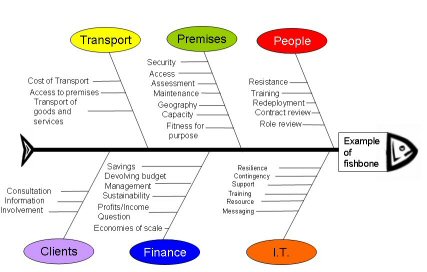
As mentioned by WBI Evaluation (2007) it is a cause and effect diagram that can be used to identify the potential causes of a performance plan and it provides a structure for group discussion around the potential causes of the problem.

Following is the structure of a fish bone diagram;


(Source: Leankaizen Ltd., 2010)

Following is an example for fish bone diagram;
(Source: Leankaizen Ltd., 2010)

References
Leankaizen Ltd. (2012) Fish bone Diagram. [image online] Available at: http://www.leankaizen.co.uk/fishbone-diagram-i-ishikawa-diagram.html [Accessed: 1 Dec 2012].